.png)

Culture , Lifestyle
World Television Day: From Doordarshan to OTT – How Television Changed, and So Did We
Remember when we all watched the same screen? Join Himanshi Lydia Singh on a nostalgic journey through television, from Doordarshan to OTT, exploring how television transformed entertainment, brought us closer with the world and afar from each other. Read on

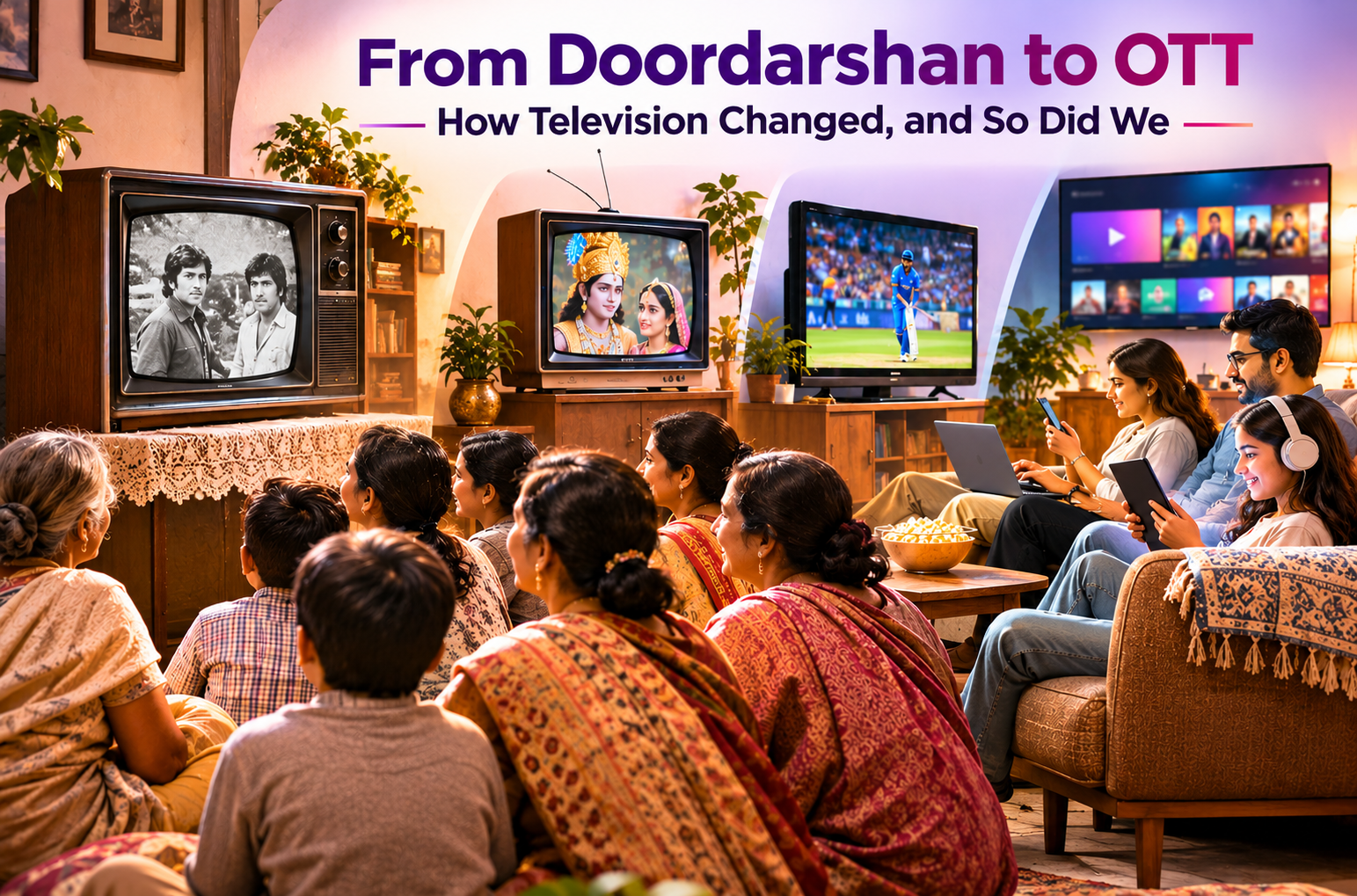
Today, on World Television Day, I found myself travelling back to a beautiful childhood memory, one that is worth sharing...I must have been seven or eight years old. We lived in a huge ancestral home in Delhi. At its centre was a large hall, with a black-and-white television – the only television not just in our house, but probably in the entire locality.
One weekday afternoon, a rumour was doing the rounds that Doordarshan was going to telecast the movie Sholay. Somehow, this piece of news had travelled across the neighbourhood.
By the time it was 3 p.m., our hall had started filling up. Around fifty neighbours, mostly women, had gathered in our home, settling down wherever they could find a place. Everyone was waiting for the movie to begin.
The television was switched on. The screen came alive with those familiar black-and-white grains. Everyone stared at it, waiting for the picture to appear.
Three o'clock passed. Then another half an hour. It was four, and there was still no Sholay. Eventually, the disappointment began to sink in. One by one, our neighbours got up and left. It was, after all, just a rumour! But imagine, fifty people gathering in one home to watch a movie that never arrived on the screen.
That was the charm of television back then. It was not merely a device for entertainment. It was an event. It brought people together, created anticipation, and gave us something to look forward to.
Those were the days!
When television was a shared experience
For many of us who grew up in the Doordarshan era, television occupied a very different place in our lives.
There were no hundreds of channels to scroll through, no remote controls to endlessly switch between programmes and certainly no option to watch an episode whenever we pleased.
We had fixed schedules. We waited for our favourite programmes, planned our evenings around them and made sure we didn't miss them. Sunday mornings had their own charm. Grew up watching Rasna Spiderman where out of 30 minutes show, 20 minutes were ads. Families gathered to watch Ramayana and Mahabharata. Chitrahaar brought music into our living rooms, while serials such as Hum Log and Buniyaad became part of our conversations.
Television was a shared experience. Neighbours discussed the previous night's episode, children talked about their favourite characters, and families sat together in front of a single screen.
We didn't have endless choices, but perhaps that was precisely what made those moments special. Everyone was watching the same thing, at the same time.
The story of television - From black-and-white screens to a world of colour
Television itself has travelled an extraordinary journey.
The first experimental television systems emerged in the 1920s. Over the following decades, mechanical television gave way to electronic broadcasting, and black-and-white television gradually found its way into homes across the world.
One of the earliest television receivers was the Baird Televisor, developed by John Logie Baird's company in the United Kingdom between 1928 and 1930. It used mechanical television technology to produce tiny, low-resolution black-and-white images.
This was followed by companies such as Telefunken in Germany, which manufactured electronic television receivers during the 1930s using cathode-ray tube technology. In the United States, RCA introduced its 630-TS television receiver in 1946–47, one of the early mass-produced electronic television sets.
In India, the journey began in 1959, when experimental television broadcasts were introduced in Delhi. Regular daily transmissions followed in 1965. Initially, television was limited in reach, but it slowly became an important medium for education, information and entertainment.
In those early years, owning a television was a luxury. J.K. TV, Weston, Televista and Dyanora were among the names that helped bring television sets into Indian homes. The television itself was often a bulky wooden or metal cabinet, with knobs to change channels and adjust the picture. As the years passed, brands such as Onida, Videocon and BPL became familiar household names, particularly during the colour television boom of the 1980s and 1990s. The television was no longer just a novelty; it was gradually becoming the centrepiece of the Indian living room.
A major milestone came in 1982, when colour television was introduced in India, coinciding with the Asian Games in Delhi. Suddenly, the world on our screens became more vibrant.
Then came the 1990s, and television underwent another transformation. Economic liberalisation opened the doors to private satellite channels. With them came a growing number of channels and brands. Zee TV, Star TV and Sony brought new programming, international content and a variety of entertainment choices into Indian homes.
Cable television expanded our viewing options. The bulky television sets gradually gave way to sleeker screens. Analogue broadcasts made room for digital technology, and high-definition pictures changed the viewing experience once again.
But the biggest disruption was yet to come.
When the television came with the internet
The arrival of the internet changed the rules of television altogether. Smart televisions, broadband connectivity and Over-The-Top (OTT) platforms transformed the way we consumed content. Platforms such as Netflix, Amazon Prime Video and Disney+ Hotstar brought an entirely new viewing experience.
We were no longer dependent on a broadcaster's schedule. We could choose what to watch, when to watch it, and even where to watch it. Missed an episode? No problem. Want to watch an entire season in one weekend? Go ahead. Want to watch a film on your phone while travelling? You could do that too. Television was no longer confined to the television set. It had moved into our laptops, tablets and smartphones.
Today, we have access to thousands of films, series, documentaries, news programmes and videos from across the world. Algorithms recommend what we might enjoy, streaming platforms compete for our attention, and content is available almost everywhere, often at any time.
From waiting for a movie to appear on a grainy screen to having an entire library of entertainment at our fingertips, the transformation has been remarkable.
Multiple screens, multiple choices. But have we lost something?
In fact, we have really progressed. We have better technology, unlimited entertainment choices and the freedom to watch whatever we want, whenever we want.
But I sometimes wonder if we have lost a little something along the way.
Remember those days when there was just one television in the house? There would be a little nok-jhok over which channel to watch. "Ab mera programme chalega!" someone would insist. "No, I want to watch the news!" another would argue. There would be a little bargaining, a little adjustment, perhaps even a little sulking, but eventually, everyone would watch together as a family.
Today, that fight is over. Now everyone has their own screen. In a family of four, one person watches a web series on the television in the living room, another catches up on the news in the bedroom, others get on to their Netflix movie on a laptop, and the fourth one doom scrolls. Four people, four screens, four different worlds.
And while I wouldn't trade the convenience of modern technology, I do miss that little nok-jhok. And perhaps, on this World Television Day, while celebrating how far technology has brought us, we should also remember the simple joy of sharing a screen. After all, sometimes the best part of watching television was not what was playing on the screen, but being together.
As I look back at that afternoon and I try to remember the faces faintly when fifty neighbours gathered in our home, waiting for Sholay to appear on our black-and-white, EC TV screen, I cannot help but smile.
Those were the days. Maybe today, on World Television Day, we can watch something together as a family.

RELATED ARTICLES






Advertisement

ABOUT THE AUTHOR
Himanshi Lydia Singh
Believer, mother, creative thinker, blogger and a compulsive entrepreneur, i love, live & write with passion.
I-221, 4th Floor, Hilton Drive Avenue, Sec-50, Gurgaon, 122018, Haryana
info@thewoomag.com
+91-8586970572